Audio Saturdays! Trousers pt. 3: Leftovers

Today and for the next few weeks we’ll be handing the reins over to poet-in-residence J.E. O’Leary, so he can tell the story of his band Trousers as he goes track-by-track through the band’s only release, 2004’s We Pitched a Hut and Called it Providence.

“LEFTOVERS”

In 1998 I moved from Albany, NY, where I attended college, to NYC. The days that followed were completely magical. I’d fallen in love, formed a band, played live, was doing some of the best art of my life and had a tight crew of some of the best friends I’d ever had. Two whirlwind years later I was out, on my way to Maine, having run out of money and goodwill. I came back about 13 months later, but much had changed. A lot of those friends had left the city. When those that remained would get together, it was different, stressful. I was learning the hard way that when people changed they changed all the way, and that while the past might not be past, one could live in such a way that it effectively was. By the time Trousers formed in late 2002, my life looked pretty different. My girlfriend had left me, and I was now living by myself. One by one the friends that remained left the city, or moved on in their own way. I guess I was pretty lonely a lot of the time.

This song was inspired by a chance encounter, sometime in 2003, with an old friend from that era. We decided to get together for a drink one night and she ended up coming home with me. Our fling itself was pretty brief, fraught with old anxieties, resentments, and brought up a lot of unpleasant stuff on both sides. What brought us together was this feeling of having been discarded, and that kind of hopeless, frustrating, desperation is not exactly the kind of thing that makes for long, happy love affairs. It is kind of perfect for a rock song however.

The song started with the bass figure that I end the song with. I’d written that two note ringing figure on the acoustic bass I had, itself leftover from the pre-Maine days. But when the song was complete enough to bring to the band, it was clear that that riff wouldn’t work for the bulk of the song, as it made everything too busy. So I reworked the verses to be this kind of plodding E-string riff. Joey kept things real simple on guitar to contrast with the power chords on the verses. The final version features some of Becca’s best cello work; in retrospect, all her parts on all the songs were so tasteful and perfect. She had such a great ear for where to put her notes – you can hear this clearly on the “bridge” of this song, where her and Joey do a double-solo, weaving in and out of each other seamlessly.

The thing that made this song perfect, however, was George’s insistence on doing this four-on-the-floor figure in the chorus. We couldn’t really seem to make it work for anything but I remember this so clearly: one time in the middle of rehearsing it, when George was getting ready to do his thump-thump part, Joey and I stopped playing at the same time and then crashed back into it. It was so perfect, we all looked at each other like YES!! and it was done. One of those magical moments in the studio I’ll remember for the rest of my life. It must have been towards the end of the session because when we were wrapping up the next band (they were either called X the Owl or they were the refugees from when X the Owl broke up) came in and seemed even more excited about it than we were. “We were listening outside, that was great!” one of them said. It was one of those artistic moments where you just know you have something great. We worked the song into our live sets pretty quickly.

I have a pretty decent vocal performance here, though I don’t really remember it being that way. This was one of the songs I was having a real problem with, as it was at the higher end of my register and I had all those high note screams to do. But listening back it seems ok. There are decent rasps where I wanted them and was able to summon my best Gordon Gano impression for the last bit of the third verse. Lyrically I was extremely satisfied. At the time I considered it one of my better lyrical efforts even though ended up I literally going through a thesaurus looking for words related to “Leftover” and worked a bunch of them into the song: “retrieve” “salvage” “scrounging” etc. I think the song has a lot of power. There’s a great reverb on the cello, and Joey’s guitar soars on the outro. I don’t recall any specific conversations about the recording, but knowing that we all had pretty similar ideas about album track placement, we must have been super high on it, slotting it in the coveted “track #3” slot – where generally the best song is supposed to go.

As for the subject of the song, I’ve said enough, though she eventually did hear the song. She said it made her “sad”, but not much else. I probably felt pretty satisfied about that at the time, though I no longer try to evoke that emotion in people. There’s more than enough around already.
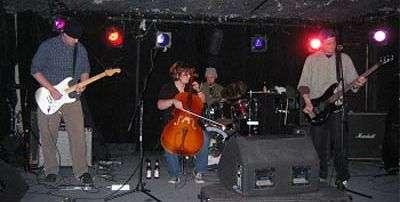
joey, becca, george, joe o. @ acme underground 2003

Audio Saturdays! Trousers pt. 1: When I Go

Today and for the next few weeks we’ll be handing the reins over to poet-in-residence J.E. O’Leary, so he can tell the story of his band Trousers as he goes track-by-track through the band’s only release, 2004’s We Pitched a Hut and Called it Providence.

TRACK ONE: WHEN I GO

It was my first time ever in a studio. I had no real idea what I was doing. Josh Clark, the engineer at Seaside Lounge in Brooklyn, where we were recording, was very patient and understanding and did his best to guide me in the right direction. The previous weekend we’d tracked the bulk of the instruments, and now it was time to do vocals. As the lead singer, I was ostensibly in charge here, but I was eager to be told what to do. I wanted to sit down as that was how I recorded most of my vocals at home. “Are you sure man? Most people find it easier to stand, you get better breath that way.” I insisted, in my quiet way. that I would like to try it like this. “Want me to dim the lights a bit? Give the room a little bit of a mood?” I gave a non answer: “Nah, I don’t know. I’m good I think.”

I’d done a few jam sessions in high school and college, but nothing that ever lead to a full band situation. I didn’t even consider myself a musician. I wanted to be a novelist. While I loved music, I never really thought I was good enough. Music, songs, bands, that was something that other people did. I had a bass, I loved picking up Bass Player magazine, I dutifully did my scales, and I could even play along with some Green Day songs, but that was the end of it. I was always too intimidated to seek out a band situation, assuming everyone would be better than me, and not knowing that that was the thing I needed to become better. It wasn’t until after college, in the summer of 1998, that I met two guys, Nolan and Daryl, that had a jam band and needed a bass player. I was down to play, but first I had to steal my bass back from a guy in Westchester, which is a story for another time.

That was my first real band situation. We played weekly in the old Funkadelic space on w. 26th street in Manhattan, did a handful of shows, and then split up when Nolan decided to put everything he owned in a couple of bags and take a bus to nowhere. That experience taught me a lot of things, but the most important was that you didn’t have to be good, just dedicated, and that if you were dedicated, good would follow. Over the next few years, as I bounced around from Queens to Brooklyn to Maine and then back to Brooklyn, I kept playing, kept getting better, and eventually started writing my own songs. My dream of being a novelist died what I assume is a pretty typical death: I wrote two novels and couldn’t sell either, got dejected, and quit. I didn’t want to spend another three years writing a novel for no one to read it or care. I needed something that had a better return on investment.

Songs were more rewarding – they were quick to write, fun to put to tape, satisfying to sing. I didn’t need to put in hundreds of hours over two or three years to see the fruits of my labor. I could work on a bunch at once. And even though I was still too intimidated to play them for people, working on them felt a lot less lonely than writing long fiction, which took hours of intense focus, living inside one’s head. Writing songs felt more free, like I could stretch out a bit. I remember very clearly the first time I improved a lyric. I was doing a G major – E minor chord progression over and over and singing la-la-la melodies and trying to think of lyrics. All of a sudden a line came out, and I thought of another line that rhymed and sang that too- it felt like I had reached out and grabbed something from the ether. I actually had to stop for a moment, as I was overwhelmed at what just happened.

As the months went on (this would be summer of 2002) songs began to pile up and I started again to think about putting a band together. I was listening to a lot of Modest Mouse at the time, so I put an ad on Craigslist saying that I wanted to do a band with an understanding of loud/quiet/loud dynamics, maybe with some non-traditional instrumentation, but focusing on melodies and big choruses that made people in the crowd want to sing along. A guy named George Loew answered my ad saying he knew exactly what I was talking about. He’d just moved from San Francisco, lived in Williamsburg, and had been taking drum lessons for a year and wanted to get a situation going. So one day he came and picked me up (I was living way out in East Brooklyn at the time) to drive me to his loft, where he had his drums. At one point during the drive my amp fell over in the back and smashed this plate glass window he had back there, but he was super cool about it. That was basically the start of the band.

Today’s song, When I Go, what would be the first track on our album, had not been written yet. That would come a few weeks later, when I’d gotten out of Brooklyn and moved to Times Square (another story for another time). It was quite the shock for me, going from a basement in Canarsie to the middle of the city, walking across eight lanes of traffic with my laundry, trying to make sense of the last few whirlwind months. If I remember, the song came together pretty quickly. I was playing around with my distortion pedal and the basic drum pattern on my Casio and made the demo one afternoon:

When I Go – from The Dreamless Sea, a collection of early tracks and demos

I loved this song when I wrote it, and it was one of the first songs I brought to the new band. However, the stomp-y, machine-like vibe of the demo never really worked the first couple of times we tried to put it together. A few months later, when Joey Amdahl had come aboard to play guitar, we reworked it into the softer, dreamier, track it is on the record. It became a great opener at shows, and showcased a lot of the dynamics we worked hard to perfect. When it came time to record the album, we made use of the Fender Rhodes Josh had at the studio to add even more layers to it.

But hitting the vocals was going to be tough. The song, in the key of A Major (in later years I would bring it all the way down to the C below), was probably slightly out of my narrow range to begin with, and I’d had a difficult night of sleep the night before. I was seated, as requested, and Josh set me up with the mic and headphones and just told me to relax. He dimmed the lights a bit on his way back to the booth and hit play. I remember this being such a nice touch, and really did settle me down. As someone who was recording vocals in a studio for the first time, I appreciated him noticing how indecisive I was, how green I was, and making the easy decisions for me.

When the music started I got real close to the mic, and tried to sing the verses real gentle, almost a speaking whisper. I remember getting a nice trill on the words “front door” in the last verse. We nailed it in the first take, and after, I said I would try the rest of the vocals standing. It’s important to listen to people who know more than you. That’s how I’ve gotten better at everything I’ve gotten better at: surrounding yourself with people who are better than you, and knowing when to shut the fuck up and listen. That being said, I was glad I did the vocals on When I Go how I did them. I think it adds a nice restrained effect to the song. I can actually hear myself not being able to get my full chest into it because I was sitting.

Looking back on the album now, there are things I would want to change and things I would do differently, but I’m super happy with how it turned out and I think it’s a good representation of the band. It’s got the power of our live show, but also showcases the playfulness with which we approached the project. It’s impossible to realize it when you’re in the middle of it, how you’re going to view it for the rest of your life. And it certainly didn’t feel this way at the time, but out of all the bands I’ve been in, it’s the recording that I’m most proud of. 20 years later, it’s still astonishing to hear that kid (!) singing, and be able to travel back to that studio, and float right back into that body, awkwardly being watched from the control room, tired, miserable (yet another long story), just trying to get it right, just trying not to waste anyone’s time.

I’ve had the good fortune to be in so many incredible bands over the years, and so many did not get the chance to record, or we blew the chance to record, or the recording ended up sounding like ass, or never getting released. There are so many bands I’ve played in that I would love to have good recordings of. It actually breaks my heart a little to think about it. Always record! Always!

NEXT WEEK: BEDTIME

Lockdown Christmas: a short film

A few weeks ago we were asked to submit a pre-recorded piece for our friend Dalton Deschain’s Third Annual Honda Days Christmas Spectacular show. There were many ways to approach this – read something from the new book, play an old Joe Yoga song, gather up the usual suspects for some collaboration, etc. But we decided we wanted to do something entirely new.

We walked around the neighborhood shooting footage of the various Christmas goings-on in Astoria, and later sat down by the old window to collect our thoughts in writing. What eventually emerged was a story of Lockdown Christmas, and we put together this short film to document it. It went over great at the Honda Days show, and we’re happy to share it with you here.

unvanquished!

It’s been an insane year, obviously, and all we can hope for our readers is to remain healthy and safe. We hope you are managing, we hope you are able to reach out to friends and loved ones and we hope you are finding reasons to be optimistic when you look for them.