Audio Saturdays! Trousers pt. 7: September 10th

Today and for the next few weeks we’ll be handing the reins over to poet-in-residence J.E. O’Leary, so he can tell the story of his band Trousers as he goes track-by-track through the band’s only release, 2004’s We Pitched a Hut and Called it Providence. Today: Track 7, September 10th

One of my favorite things about being in a band and starting out was those hour long jam sessions. No agenda, no “working on” anything, just the band, some beers, some weed, and saying GO. It’s an exercise in improvisation, in creativity, and in endurance, both mentally and physically. We had to physically be able to play for that long – wasn’t the goal headlining shows? We would have to be able to play without taking breaks. We wouldn’t be able to walk off stage in the middle of a set and take a smoke break. Long jamming sessions also tested my mental creativity, and listening skills. If we could keep things interesting for long stretches, just jamming, not working on material, that meant we were listening well and exploring, flexing those creative muscles. These sessions were also great for writing as a band. I loved writing a song and bringing it to the band, but I also loved coming up with something brand new as a foursome. September 10th was one of those songs.

There’s no big meaning behind us calling it September 10th. The jam session where we came up with the skeleton of what became the song was literally on September 10th. We probably passed the tape around and at subsequent rehearsals would label it “September 10th jam”. Also we thought the jam sounded foreboding and sinister, and naming it after the day before an awful day seemed to fit. I don’t remember specifically how it came about, but I remember collecting those basslines from a D minor jam and putting them together – the arrangement just kind of came together. I tried to write words for it once, but the vibe was really off putting. I think in the Tape Box somewhere there is a really early version of me singing over it, but we ditched the idea pretty quick. It didn’t need a vocal part.

I definitely sound like a broken record at this point, but Joey’s guitar parts on this are perfect as usual. He had such a great feel for the dynamics of a song and how to push it forward. And having a classically trained musician like Becca in the band was such a great asset. She was always careful to never overwork any part, and knew exactly how to find her place in a song, even loud of busy parts. I could probably count on one hand the number of times we got too loud/busy/crazy for her and she just threw up her hands and was lost. There’s such a great achy quality to her parts here, especially in the first movement.

There’s a little studio magic happening in the way the two sections were bridged, but listening to it all these years later, it sounds fine. George is really hustling and pushing on the second movement, and though there’s a bit of a hesitation as we come out of the first, you can hear the moment we click, and it really takes off. The overall performance is solid, and, like Nothing Is Wasted, a good representation of what we were doing when we were at our best, and indicative of the kind of collaborative, urgent vibe we would have pursued, given a little more time.

When we walked in to the studio for the first time, we saw they had a gong set up behind the drum kit. “I don’t know what song it’s going to be,” George said. “But I’m hitting that gong on something.” We were all in agreement. When we were listening to the first mix in the booth, we all kind of looked at each other at the same time at the part. George made a hitting-the-gong motion. We did the overdubs right there. It sounds righteous. We were all so thrilled to have a gong on the record, we specifically called it out in the album credits.

None of us were sure where that little curly tail of a note at the beginning came from. It’s definitely Joey, We assume it was a trailing note left on the tape from whatever song we did before, but we did not notice it until it came time to master the recording. We’d gathered at a little basement in Chinatown on a Sunday with a “budget” master guy we found off of Craigslist. The little note is another one of those happy accidents that you find during the process. But by this time we were already aware that the end was near for the band, and the mastering sessions had an air of melancholy to them, even though we were all finishing something we were really proud of.

The one thing I remember from the mastering sessions is that it ended up being more expensive than we thought. I came in to it thinking it was going to be $60 each, but I must have read the email wrong because it ended up being almost twice that, and I went out to one of those bodega ATMs to get more money. It charged me a fee and left me with less that $20 for the week, and that depressed me even more than any of the other stuff going on. I remember thinking, at the ATM, I’m flat broke and I’m losing my band. If this isn’t a sign I need to get my shit together, I don’t know what is.

It would take me a little longer, in fits and starts, two steps forward one step back, but more than anything that was the moment. By that time next year I would have a new job, and more money, but I was in a new band I wasn’t happy in. But that’s a story for another series.

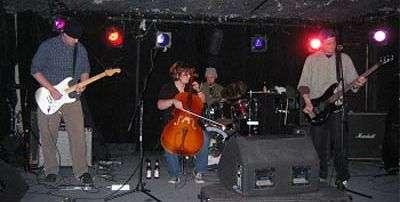
Trousers live at the Acme Underground in NYC, 2003, (probably)

Audio Saturdays! Trousers pt. 6: Nothing is Wasted

Today and for the next few weeks we’ll be handing the reins over to poet-in-residence J.E. O’Leary, so he can tell the story of his band Trousers as he goes track-by-track through the band’s only release, 2004’s We Pitched a Hut and Called it Providence.

“It’s so nice when it happens good…”

Nothing Is Wasted was one of the last songs Trousers came up with. I had the riff – just a basic 1-4-5 plucked with the pick, but really nothing else. We jammed on it for a while before lyrics came, and the bridge is just a minor 6th – pretty standard Songwriting 101 stuff. I don’t even have any drama associated with this song. The lyrics aren’t about anything or anyone in particular, the recording sounds really good, and aside from one vocal miss (there’s supposed to be a big scream on the last “see the worrrrrrrrrrld!”) I’m happy with how I sound personally.

The song starts off with George on the drums, and it’s probably his best performance on the record. The beat is strong and fun and driving. I think had Trousers continued, we probably would have done a lot more stuff in this vein, upbeat dance-y melodic songs. There was a lot of that going on in Brooklyn in 2003-2004, and it probably would have gone over really well. The cowbell is classic – we’d been waiting for a song to use it on, and this was perfect. Joey’s sliding notes really push the song forward, and are where most of the dynamics come from. He always had a great knack for that stuff.

As you can tell, there’s not a lot going on in this song, so we added another track with Becca on the Wurlitzer, split off to the right. There’s a really great off-note at around 1:16-1:18, it comes in flat, but it sounds so good. One of those happy accidents you hope and pray will arrive at recording time. Her call and response vocals are great too. That is another element I think would have wanted to move to the front had Trousers continued. Her voice was really perfect for a lot of our material. I think we had a real streak of optimism, playfulness, and humor in our music and her voice was really expressive in that lane.

I think there’s a relatively celebratory tone to the lyrics. “Nothing is wasted” stands as kind of the faster, complimentary song to “When I go” – there’s a lot of the same tone to the lyrics. Which is interesting to me because when I initially wrote When I Go it had a similar vibe to Nothing is Wasted (though a lot slower). They both had that root-5, root-5, root-5 picking on the bass and a minor 6th chorus.

I think there’s a little distortion on my voice in the low end (?) – probably the engineer trying to cover up the fact that my voice was a bit thin that day. The only thing I’m not happy with in this song is the second “nothing is shorter than June” – where I draw “June” out and it sounds flat (emotionally not musically, though maybe there too). But overall this song stands as a good representation of where we were as a band and where we potentially could move: tighter band, better dynamics, more involvement up front from the other members. Something I learned pretty early on (and shocked me when I did) was that not every emotional song needs to have high drama around every element of its execution. I knew this for fiction writing, but it took me quite a long time to put that particular two and two together. It was quite a relief when I did.

n.b. the song’s title (and main theme) is apparently stolen from Charles Bukowski, whose “Dark Night Poem” reads: “they say that / nothing is wasted / either that / or / it all is” … Now, I don’t remember specifically lifting this, but I was quite the Buk fan at the time, so I without a doubt had come across it. Sorry Chuck. But thanks!

Trousers live in NYC at the ACME Underground. it was a good year for dudes to wear hats on stage I guess

Audio Saturdays! Trousers pt. 5: Complicado

Today and for the next few weeks we’ll be handing the reins over to poet-in-residence J.E. O’Leary, so he can tell the story of his band Trousers as he goes track-by-track through the band’s only release, 2004’s We Pitched a Hut and Called it Providence.

It took a long time for me to get this right. The song started with the bass riff that kicks off the song, but I was hearing the whole symphony in my head from the beginning. The version that ultimately got laid down on tape was – the best word I can come up with for it is correct. All the parts are there, the notes are there, the verses are in the right sequence, but something is missing. Listening to it now, the thing that’s missing is me.

When my girlfriend finally moved out in May 2002 I had the whole house to myself. I was alone all summer in the east end of Brooklyn. The few friends I did have were either in Manhattan, Long Island, or the Bronx. So I had a lot of time to myself I smoked weed and cigarettes and drank beer and played around with my four track. I jammed on C-Am forever. I did little fills each time. I was channeling something larger, something I wasn’t ready for. So I waited and waited. There was the first part. The second part was C, B, then descending to something else. I could hear it in my head but didn’t know where it was on the bass. I tried every note in the C scale, but none of them worked. Eventually I found it – A flat with an E over it. I remember how amazing it was to hear it, finally. I didn’t know why it worked – but it did. From there, I was able to get the third part – F – Am. Then resolved it back to C, where verses would come in. From there is came together pretty quickly. I added the verses and then by the time it got back to the F part, there would be a quiet part into a loud jam. It would be a real showstopper – a multi part epic ripe for long jams at the beginning and a fierce rock out at the end. The kind of song you could stretch out and have wild live versions.

After George and I jammed that first time, we started making plans to put a band together. Our first guitarist was named Tom. We spent about half the time working on his songs, and half working on mine. When I brought this unnamed song to the band, none of us had the musical vocabulary we needed to be able to describe the parts, so we ended up diagramming it out on big sheets of paper and hanging them up on the wall. Verse part one > Verse part two, etc. Everyone was into it. George named the song; at one point I was clarifying something on the chart and he stood with his hands on his hips looking sideways at it. “Es complicado,” he said. This is complicated.

As far as the band was concerned, we had a name – Sketch – and plans to add another element to the mix. I was pretty set on getting a cello player for some reason, but we did bring in a couple of keyboard players. One day we brought in a guy named Kartik. He had a huge 88 key Yamaha and serious chops. He was blowing us away. When it came time to do this song, we broke out the charts and hung them on the wall. When I was telling him the chords for the different sections, I brought up the mystery A flat chord. “I don’t know what this chord is, but it works,” I said. Kartik ran some scales and we went through the part. He squinted while he played. Then he landed on a chord that rang out. “Oh,” he said “It’s E7”. I didn’t understand how E7 could fit into a C major key (still don’t) but I was grateful to finally have an answer. Kartik didn’t work out (I think we all thought he was too good), but I’ll always remember him giving me that chord.

The recording is pretty close to how I heard it in my head, bass-wise. Re-listening now I think there could have been fewer runs, especially during the first part, but there were so many notes in there that I’d come up with, and I wanted to put as many down on tape as I could. The real stand out here is Becca’s cello part, absolutely perfect, especially her haunting sustained notes at 5:00 – 5:15 or so. I hate my voice here. It’s thin and weak as a result of being out all night and not getting any sleep – tossing and turning over a girl that I was infatuated with. This was someone I had known as a friend for a long time, it briefly turned into something more before she pulled back. We basically got to have one perfect day – a day that became its own song.

In the moment, I was devastated. It’s just too bad that the worst day for me just happened to be the day before we were recording vocals. I couldn’t hit notes. I was totally unfocused. The whole band was pissed, and rightfully so. The next day of recording went better, but we didn’t have time to re-do Complicado, only auto-tune some of the worst parts. It’s hard to listen to now, only because I still hear what I heard that summer when I was writing it in my Canarsie basement. It’s not a track about which I’m really able to give a fair judgement. Except to know that I could have, should have done better. And that’s not really the way you want to feel about anything you’ve done that was supposed to be important to you. So listening to it now just makes me melancholy.

But the song itself? One of the things I’m most proud of having written. Despite the tongue-in-cheek lyrics, I love the melodies, I love the arrangement, I love the “stop love” breakdown. It really brings back 2002-2003 to me – hanging out in Williamsburg with George, then heading back to Canarsie on the L, crushing on hipster girls who wouldn’t get off their cellphones, reading missed connections, hoping. I love the honesty of the lyric “I know you want to see the west as bad as I do”. I still hadn’t been out west yet, despite my lifelong obsession. There’s a double meaning in the lyric, for when paired with the next line, I’m then talking about west Brooklyn. It’s funny that there’s a Trousers connection to when I finally did get out west, as it was to visit Joey and Becca, who’d moved away. There’s a self fulfilling prophecy within all of us, I guess, if we just listen for long enough.

Audio Saturdays! Trousers pt. 4: It Hurts Me More Than You

Today and for the next few weeks we’ll be handing the reins over to poet-in-residence J.E. O’Leary, so he can tell the story of his band Trousers as he goes track-by-track through the band’s only release, 2004’s We Pitched a Hut and Called it Providence.

The first time I ever played music in front of a crowd, it went about as badly as it could have possibly gone. I was playing with my first band, a jam band called IT, at legendary NYC venue CBGBs at one of their Sunday night showcases. As a huge fan of the CBGBs scene in the 70s and bands like the Ramones, Talking Heads, Patti Smith, Lou Reed, I had hyped up the gig in my own head past the point of any realistic expectations. However, literally four measures into the first song, I popped a bass string for the first time in my life. I didn’t even realize what was happening at first; I’d never broken a bass string in almost ten years of playing. The string just kind of disappeared under my fingers. Once I put it together, I panicked, as I didn’t even know if I had extra strings and my gig bag wasn’t even onstage. I ran off the stage and frantically tried to find my gig bag in a sea of identical black gig bags. The band meanwhile, just started improving on the main riff of the song (an E blues). Eventually I did find it, and it had my extra strings. I put it on as fast as I could and got back onstage. The rest of the show (for me) was a mess, finding myself out of tune more than not. At one point while I was tuning, I couldn’t get it, and Nolan, the guitar player, had to come over and tune it for me. It was a pretty embarrassing spectacle, even more so given the stakes I’d given it, along with the fact I felt I’d let the band down. We didn’t get asked back, and were broken up less than two months later anyway. So by any standards, it was a disappointment.

Despite all the craziness however, it was unbelievably fun. We had a bunch of friends show up, smoked blunts in the basement, partied at the bar, and brought the whole circus back to Nolan’s Brooklyn apartment where we smoked and drank and played music all night. I had my acoustic bass there (I would end up moving in pretty soon, but am unsure if I was already in by that point) and we just spent the night jamming, reading poetry, smoking weed, and getting drunk. Any bad feelings from fucking up the gig were a million miles away. Everyone was having a blast. At one point, I started playing this bassline, based around an Am scale, just up and down. Kinda funky, kinda dirty. I looked over at our keyboard player, Daryl, and he was deep into a vibe, singing something. When I listened closer, I could make it out. “It hurts me… it hurts me more… it hurts me… it hurts me more…”

A few years later, when George and I jammed for the first time at his loft on North 6th street, we were mostly just improvising, feeling each other out. I was never the kind of guy that knew a lot of covers, so we were kind of wanting for material. At some point I busted this riff out and we worked on it. I had the lyrics – we’d never really turned it into a formal song, mostly because the band broke up, but I loved the riff/lyric combo, and it was easy to play & sing at the same time, so it was one piece that was always in my repertoire. So it was kind of natural that it would be a song. I always wanted to keep it fast and short, and real simple, some kind of cross between Violent Femmes and the Ramones. Two verses, a cello solo, a guitar solo, and a third verse and that was it. It clocks in at 2:22, but it always seemed long even at that.

I never liked the third verse. I couldn’t decide between the lyrics we eventually ended up with and my alternate version:

It hurts us, it hurts us more than them
It hurts us, oh, and it will ever end
It hurts us, oh it hurts us more than them
It hurts us, oh hurts us more than them

lost third verse

That would perhaps be more natural after “It hurts me more than you” and “It hurts you more than me”, the two lyrics that start the first two, but I think I was going for more of an edge at that point, and chose what you hear on the album. Reflecting back on it, it seems pretty clear that I chose poorly.

There’s not a lot to say about the recorded version. There’s a nice reverb on the cello, and I have some nice bass figures under the guitar solo. But it is what it is. And to my knowledge it’s maybe the only song from the IT era that survive in some official recorded form. I did solo acoustic versions of our songs “The Ballad of Bubbe and Zayde” and “Breath of Life” a handful of times, and I still know the basslines to most of the songs, including Nolan’s ” Pimpin’ “, the song on which my A string flew out from under my fingers at CBGBs all those years ago. But as a recorded song, it stands alone. I don’t think it was ever going to capture the manic raw energy of those Brooklyn years, but how could it? I mean, check out this completely spaced out version from a 1999 rehearsal:

Or the insane “Where the fuck am I?” energy from this version from the one time we played in Maine, at a place called The Wharf (4/24/2000 according to the tape):

Perhaps some things are best viewed from a distance.

Audio Saturdays! Trousers pt. 3: Leftovers

Today and for the next few weeks we’ll be handing the reins over to poet-in-residence J.E. O’Leary, so he can tell the story of his band Trousers as he goes track-by-track through the band’s only release, 2004’s We Pitched a Hut and Called it Providence.

“LEFTOVERS”

In 1998 I moved from Albany, NY, where I attended college, to NYC. The days that followed were completely magical. I’d fallen in love, formed a band, played live, was doing some of the best art of my life and had a tight crew of some of the best friends I’d ever had. Two whirlwind years later I was out, on my way to Maine, having run out of money and goodwill. I came back about 13 months later, but much had changed. A lot of those friends had left the city. When those that remained would get together, it was different, stressful. I was learning the hard way that when people changed they changed all the way, and that while the past might not be past, one could live in such a way that it effectively was. By the time Trousers formed in late 2002, my life looked pretty different. My girlfriend had left me, and I was now living by myself. One by one the friends that remained left the city, or moved on in their own way. I guess I was pretty lonely a lot of the time.

This song was inspired by a chance encounter, sometime in 2003, with an old friend from that era. We decided to get together for a drink one night and she ended up coming home with me. Our fling itself was pretty brief, fraught with old anxieties, resentments, and brought up a lot of unpleasant stuff on both sides. What brought us together was this feeling of having been discarded, and that kind of hopeless, frustrating, desperation is not exactly the kind of thing that makes for long, happy love affairs. It is kind of perfect for a rock song however.

The song started with the bass figure that I end the song with. I’d written that two note ringing figure on the acoustic bass I had, itself leftover from the pre-Maine days. But when the song was complete enough to bring to the band, it was clear that that riff wouldn’t work for the bulk of the song, as it made everything too busy. So I reworked the verses to be this kind of plodding E-string riff. Joey kept things real simple on guitar to contrast with the power chords on the verses. The final version features some of Becca’s best cello work; in retrospect, all her parts on all the songs were so tasteful and perfect. She had such a great ear for where to put her notes – you can hear this clearly on the “bridge” of this song, where her and Joey do a double-solo, weaving in and out of each other seamlessly.

The thing that made this song perfect, however, was George’s insistence on doing this four-on-the-floor figure in the chorus. We couldn’t really seem to make it work for anything but I remember this so clearly: one time in the middle of rehearsing it, when George was getting ready to do his thump-thump part, Joey and I stopped playing at the same time and then crashed back into it. It was so perfect, we all looked at each other like YES!! and it was done. One of those magical moments in the studio I’ll remember for the rest of my life. It must have been towards the end of the session because when we were wrapping up the next band (they were either called X the Owl or they were the refugees from when X the Owl broke up) came in and seemed even more excited about it than we were. “We were listening outside, that was great!” one of them said. It was one of those artistic moments where you just know you have something great. We worked the song into our live sets pretty quickly.

I have a pretty decent vocal performance here, though I don’t really remember it being that way. This was one of the songs I was having a real problem with, as it was at the higher end of my register and I had all those high note screams to do. But listening back it seems ok. There are decent rasps where I wanted them and was able to summon my best Gordon Gano impression for the last bit of the third verse. Lyrically I was extremely satisfied. At the time I considered it one of my better lyrical efforts even though ended up I literally going through a thesaurus looking for words related to “Leftover” and worked a bunch of them into the song: “retrieve” “salvage” “scrounging” etc. I think the song has a lot of power. There’s a great reverb on the cello, and Joey’s guitar soars on the outro. I don’t recall any specific conversations about the recording, but knowing that we all had pretty similar ideas about album track placement, we must have been super high on it, slotting it in the coveted “track #3” slot – where generally the best song is supposed to go.

As for the subject of the song, I’ve said enough, though she eventually did hear the song. She said it made her “sad”, but not much else. I probably felt pretty satisfied about that at the time, though I no longer try to evoke that emotion in people. There’s more than enough around already.

joey, becca, george, joe o. @ acme underground 2003

Audio Saturdays! Trousers pt. 2: Bedtime

Today and for the next few weeks we’ll be handing the reins over to poet-in-residence J.E. O’Leary, so he can tell the story of his band Trousers as he goes track-by-track through the band’s only release, 2004’s We Pitched a Hut and Called it Providence. This week: track #2, “Bedtime”

This song is pretty much peak Trousers. We wrote it at the height of our powers and it was one of our favorites to play live. Joey, our guitar player, wrote the verse riff and brought it to us to jam on. I came up with the bassline during the jam and started thinking about lyrics. In cases like this I would just kind of sing la-la-las until lyrics came to me. I had pretty much fully transitioned to playing with a pick at this point. It made singing way easier.

Singing and playing the bass at the same time had not come naturally to me. When I first began playing bass, I couldn’t do it at all. It was almost like you needed two brains in your head at once. But by the time Trousers was in full swing, I’d been playing bass for about ten years, just about every day, and I’d had some experience doing background vocals and leads (with very simple lines under them). I’d also picked up some basic guitar skills along the way, which gave me experience playing and carrying a tune. I found that using a pick on my bass let me think of my right arm as it were strumming chords, and I could accompany myself on increasingly difficult basslines. And as always you learn different ways to cheat a little when you need to.

During practice we developed the verses and they were looking strong. I told the band I would take the song home and try and write a chorus. I was still in my Early Period of songwriting at this point, and didn’t really know many tricks besides the basics, so I figured since this song was in F (the verse was F- Dm), I would go major 4th and hit the chorus in A#. It didn’t really sound right on the first fret, so the next time around I slid up to the 13th fret and added that power chord on the 5th, and that sounded so good. A couple of tweaks later and I had the right feel. The chorus ended up major 4th major 5th, which worked. Joey worked out a great ascending power chord part on the chorus to give it some real oomph.

I was pretty proud of the lyrics on this one. They basically came straight from a dream. In my dream I was literally in the 110th subway station on the 1/9 talking to my ex (who I hadn’t seen in years by this point). I also remember I couldn’t think of a second line for the 4th verse after “Am I holding your hand or fondling my alarm clock” so I just repeated it and it kinda stuck,

It was Becca’s idea to call it Bedtime, and we had a running joke about her cello part. When I finish with “but what good does it do meeee” she slides up to a really high note and I would always try to match it with a falsetto. We always cracked each other up trying to reach the high note.

afaik the only extant picture of TROUSERS

Audio Saturdays! Trousers pt. 1: When I Go

Today and for the next few weeks we’ll be handing the reins over to poet-in-residence J.E. O’Leary, so he can tell the story of his band Trousers as he goes track-by-track through the band’s only release, 2004’s We Pitched a Hut and Called it Providence.

TRACK ONE: WHEN I GO

It was my first time ever in a studio. I had no real idea what I was doing. Josh Clark, the engineer at Seaside Lounge in Brooklyn, where we were recording, was very patient and understanding and did his best to guide me in the right direction. The previous weekend we’d tracked the bulk of the instruments, and now it was time to do vocals. As the lead singer, I was ostensibly in charge here, but I was eager to be told what to do. I wanted to sit down as that was how I recorded most of my vocals at home. “Are you sure man? Most people find it easier to stand, you get better breath that way.” I insisted, in my quiet way. that I would like to try it like this. “Want me to dim the lights a bit? Give the room a little bit of a mood?” I gave a non answer: “Nah, I don’t know. I’m good I think.”

I’d done a few jam sessions in high school and college, but nothing that ever lead to a full band situation. I didn’t even consider myself a musician. I wanted to be a novelist. While I loved music, I never really thought I was good enough. Music, songs, bands, that was something that other people did. I had a bass, I loved picking up Bass Player magazine, I dutifully did my scales, and I could even play along with some Green Day songs, but that was the end of it. I was always too intimidated to seek out a band situation, assuming everyone would be better than me, and not knowing that that was the thing I needed to become better. It wasn’t until after college, in the summer of 1998, that I met two guys, Nolan and Daryl, that had a jam band and needed a bass player. I was down to play, but first I had to steal my bass back from a guy in Westchester, which is a story for another time.

That was my first real band situation. We played weekly in the old Funkadelic space on w. 26th street in Manhattan, did a handful of shows, and then split up when Nolan decided to put everything he owned in a couple of bags and take a bus to nowhere. That experience taught me a lot of things, but the most important was that you didn’t have to be good, just dedicated, and that if you were dedicated, good would follow. Over the next few years, as I bounced around from Queens to Brooklyn to Maine and then back to Brooklyn, I kept playing, kept getting better, and eventually started writing my own songs. My dream of being a novelist died what I assume is a pretty typical death: I wrote two novels and couldn’t sell either, got dejected, and quit. I didn’t want to spend another three years writing a novel for no one to read it or care. I needed something that had a better return on investment.

Songs were more rewarding – they were quick to write, fun to put to tape, satisfying to sing. I didn’t need to put in hundreds of hours over two or three years to see the fruits of my labor. I could work on a bunch at once. And even though I was still too intimidated to play them for people, working on them felt a lot less lonely than writing long fiction, which took hours of intense focus, living inside one’s head. Writing songs felt more free, like I could stretch out a bit. I remember very clearly the first time I improved a lyric. I was doing a G major – E minor chord progression over and over and singing la-la-la melodies and trying to think of lyrics. All of a sudden a line came out, and I thought of another line that rhymed and sang that too- it felt like I had reached out and grabbed something from the ether. I actually had to stop for a moment, as I was overwhelmed at what just happened.

As the months went on (this would be summer of 2002) songs began to pile up and I started again to think about putting a band together. I was listening to a lot of Modest Mouse at the time, so I put an ad on Craigslist saying that I wanted to do a band with an understanding of loud/quiet/loud dynamics, maybe with some non-traditional instrumentation, but focusing on melodies and big choruses that made people in the crowd want to sing along. A guy named George Loew answered my ad saying he knew exactly what I was talking about. He’d just moved from San Francisco, lived in Williamsburg, and had been taking drum lessons for a year and wanted to get a situation going. So one day he came and picked me up (I was living way out in East Brooklyn at the time) to drive me to his loft, where he had his drums. At one point during the drive my amp fell over in the back and smashed this plate glass window he had back there, but he was super cool about it. That was basically the start of the band.

Today’s song, When I Go, what would be the first track on our album, had not been written yet. That would come a few weeks later, when I’d gotten out of Brooklyn and moved to Times Square (another story for another time). It was quite the shock for me, going from a basement in Canarsie to the middle of the city, walking across eight lanes of traffic with my laundry, trying to make sense of the last few whirlwind months. If I remember, the song came together pretty quickly. I was playing around with my distortion pedal and the basic drum pattern on my Casio and made the demo one afternoon:

When I Go – from The Dreamless Sea, a collection of early tracks and demos

I loved this song when I wrote it, and it was one of the first songs I brought to the new band. However, the stomp-y, machine-like vibe of the demo never really worked the first couple of times we tried to put it together. A few months later, when Joey Amdahl had come aboard to play guitar, we reworked it into the softer, dreamier, track it is on the record. It became a great opener at shows, and showcased a lot of the dynamics we worked hard to perfect. When it came time to record the album, we made use of the Fender Rhodes Josh had at the studio to add even more layers to it.

But hitting the vocals was going to be tough. The song, in the key of A Major (in later years I would bring it all the way down to the C below), was probably slightly out of my narrow range to begin with, and I’d had a difficult night of sleep the night before. I was seated, as requested, and Josh set me up with the mic and headphones and just told me to relax. He dimmed the lights a bit on his way back to the booth and hit play. I remember this being such a nice touch, and really did settle me down. As someone who was recording vocals in a studio for the first time, I appreciated him noticing how indecisive I was, how green I was, and making the easy decisions for me.

When the music started I got real close to the mic, and tried to sing the verses real gentle, almost a speaking whisper. I remember getting a nice trill on the words “front door” in the last verse. We nailed it in the first take, and after, I said I would try the rest of the vocals standing. It’s important to listen to people who know more than you. That’s how I’ve gotten better at everything I’ve gotten better at: surrounding yourself with people who are better than you, and knowing when to shut the fuck up and listen. That being said, I was glad I did the vocals on When I Go how I did them. I think it adds a nice restrained effect to the song. I can actually hear myself not being able to get my full chest into it because I was sitting.

Looking back on the album now, there are things I would want to change and things I would do differently, but I’m super happy with how it turned out and I think it’s a good representation of the band. It’s got the power of our live show, but also showcases the playfulness with which we approached the project. It’s impossible to realize it when you’re in the middle of it, how you’re going to view it for the rest of your life. And it certainly didn’t feel this way at the time, but out of all the bands I’ve been in, it’s the recording that I’m most proud of. 20 years later, it’s still astonishing to hear that kid (!) singing, and be able to travel back to that studio, and float right back into that body, awkwardly being watched from the control room, tired, miserable (yet another long story), just trying to get it right, just trying not to waste anyone’s time.

I’ve had the good fortune to be in so many incredible bands over the years, and so many did not get the chance to record, or we blew the chance to record, or the recording ended up sounding like ass, or never getting released. There are so many bands I’ve played in that I would love to have good recordings of. It actually breaks my heart a little to think about it. Always record! Always!

NEXT WEEK: BEDTIME

Audio Saturdays! Sound collage #1

We know, we know. We’ve gotta stop leaving these until the last minute. Here’s a little sound collage from a folder deep inside the Sunshine and Wind archives called RANDOM WAV FILES. No clue the story behind this. But maybe someone can find some use for it.

It’s a beautiful morning here in Queens, and we’re recovering from a fairly bad back strain, so not much work has gotten done this week. But we’ve got a chunk of time carved out tomorrow to do some fairly heavy lifting, site wise, so expect these posts to be higher effort in the coming weeks. In the meantime, here is a picture from the summer. We actually considered this for the WHAT A FUTURE cover, but decided it was too Instagram-y and not representative of the mood of the book.

Audio Saturdays! Songwriting Prompt contest #2

If you were around last weekend, you heard Todd Jackson’s great new single that he had submitted for the last Audio Saturdays! Songwriting Prompt Contest. We threw in the next prompt at the bottom of the page, but we’ve had a lot of interest so we figured it deserved its own post.

Also, we had a busy week! As a result, we were not able to get a proper Audio Saturdays! post up. So we figured we’d take this opportunity to make this a Thing and clarify the rules and guidelines.

  1. Using the audio prompt below, write a song or musical piece. It can be inspired by any aspect of the clip: the chords, the lyrics, the melody, the key, or something else.
  2. Submit the song to info@sunshineandwind.com by end-of-day Sunday February 21. When we check our email Monday 22, that’s it! No late entries will be accepted!
  3. Our staff will judge our favorite and pick a winner. The winner will be announced sometime that week and receive $50 and their own feature on a forthcoming “Audio Saturdays!” post.

That’s it! The prompt is below! It’s called only “B Minor Demo”

Audio Saturdays: Todd Jackson and a new contest!

Today on Audio Saturdays we bring you the newest audio prompt contest and a new track from Brooklyn based singer-songwriter Todd Jackson, winner of the last contest!

A few weeks ago, we put up an Audio Saturdays post containing a random voice memo of ours from years (?) ago and kind of on a whim offered $50 bucks to the first person to create a song out of it. We didn’t expect anything to come of it, and subsequently forgot about it, but boy are we glad that you didn’t, because a few weeks later we received this incredible track from Brooklyn based Singer-Songwriter Todd Jackson called “What the World Thinks”:

TODD JACKSON: WHAT THE WORLD THINKS

We first met Todd back when we were both living in Manhattan, and circling around the East Village open mic scene. He was working a lot with NYC guitar legend Mike Milazzo, and later was writing and performing with another songwriter, Brooke McGowan. Gonna plug an earlier track of his here, because we love it so much: Where’s the Girl Gone? We’ve always admired his songcraft and meditative lyrics, and were psyched to hear that he was writing new music. We caught up with him a bit on email, asking for a little background on the track.

Q: Hey Todd, thanks for submitting your track and letting us feature it. It’s great to hear what friends have been working on. How have you managed to stay creative during quarantine?

Todd: Being locked inside for so long certainly has helped with music since all my other distractions are cut off. The tech these days is amazing and cheap so I’m able to do things that 10 years ago would have involved a lot more money and people. However, I do miss hearing people play live which was always inspiring.

Q: Speaking of home recording, one thing we love about this track is the drum sound and execution. Back in our own singer songwriter days, one thing that always stymied us was recording drum machine tracks. Could never quite get it right. Could you tell us a little about how you put it together?

TODD: I’m always aiming for an organic sound, so I start with rhythm guitar played to a click track. Then, using EZDrummer2, I find a simple kick drum pattern that fits the guitar. EZDrummer then gives you a selection of patterns with that kick drum incorporated. With a large library, I pick the best one that has verse and chorus parts, sometimes editing if I can’t find the perfect one, slowly opening up the hi-hat as the song progresses. Then I add bass to bridge the gap between guitar and drums, layering on from there, I am always refining the process.

Q: We’ve always been a huge fan of your lyrical approach. You always have a real conversational feel without taking the listener out of the rhythm of the song. How to you go about constructing a lyric?

TODD: I read a lot of poetry which helps with phrasing. Normally I’ll find a loose theme to start (prompts are great for this). Then I let my subconscious take the first pass, slowly editing and focusing the meaning while avoiding being too “on the nose.” After that, I refine with alliteration, assonance, hopefully giving the words some music of their own and giving the listener some room for interpretation.

Q: What’s next for Todd Jackson? We want more recordings!

TODD: My goal last year was to start recording some music, leading to a nicely recorded EP with real musicians. COVID has obviously delayed this but I’m hoping this summer I’ll get back on track.

As do we, Todd, as do we! And now – THIS MONTH’S PROMPT!!

Just like last time, submit a song using this prompt and I’ll pick the best one. Winner gets $50 (or $50 donated to the charity of your choice) and a feature interview in this space. This prompt comes to you from our folder 2011 DEMOS. It’s only called “B Minor Demo”. GOOD LUCK!

B MINOR DEMO